Happening Now
Mardi Gras to Jacksonville? A Second Crescent? Nope
May 27, 2026
by Jim Mathews / President & CEO
We all have things we deeply, desperately want to be true. But in a world in which the unscrupulous, the deceptive, or simply the naïve have access to AI-driven creation tools, the risks that come from passing along things that just feel so right...can be pretty wrong.
Unfortunately, there’s a lot of that going on in passenger rail. I can’t tell you how many times in a typical week I get an email from a donor or supporter letting me know about some really fantastic development that I really should say something about.
Trouble is, 99.99 percent of the time, it just ain’t so.
One came to me last week breathlessly claiming that Amtrak was already running a new train called the Mountaineer ( ! ) extending Gulf Coast service (currently between New Orlans and Mobile) to Jacksonville, along with a second daily Crescent between New York City and New Orleans.
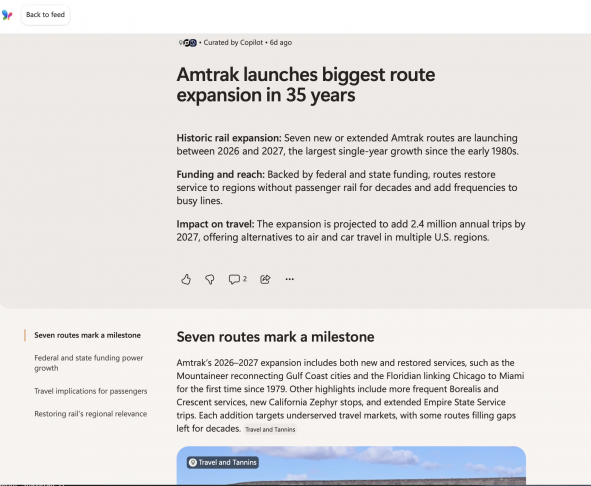
Sheer, utter, compleat nonsense. How many of you have ridden this “Mountaineer” to Jacksonville yet? Anyone? It launched last year, supposedly, so somebody must have. Or, I’ll wait here while you go search Amtrak.com to book on one of the two (alleged) daily Crescents. C’mon, gang. It was reposted by MSN, the longtime online news aggregator, but look closely at the actual source. Travel and Tannins. Anyone want to tell us who “Travel and Tannins” is?
Or how about this one, just this week, contending that thanks to the Infrastructure Investment and Jobs Act (IIJA), also known as the Bipartisan Infrastructure Law, “America is electrifying its Amtrak long-distance train network -- the passenger rail service connecting 500 cities getting the clean electric overhaul it has needed for half a century.”
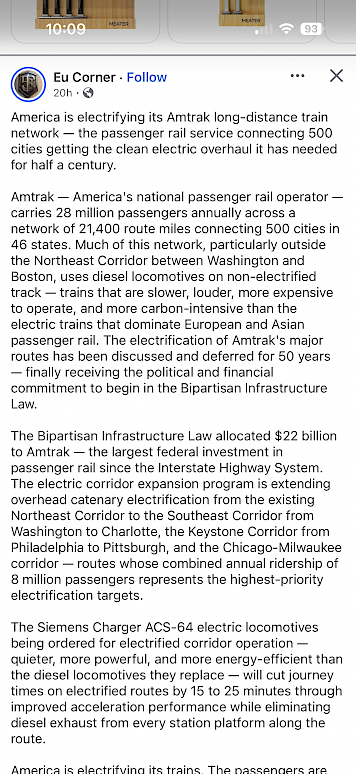
Really?
Considering that the long-distance services all run on someone else’s right-of-way, how would Amtrak even do that? And if that were really a provision in the IIJA, don’t you think we’d all know it by now since the bill became law five years ago, in 2021?
Psychologists and social scientists have been looking at this phenomenon pretty closely in recent years, given how easy it is today to pass along genuine junk, blurring the line between fact and fantasy and polluting the “marketplace of ideas” with poisonous sludge.
One of the major reasons people pass along fake news is because it aligns precisely with their preconceived notions or, worse, with their deepest hopes. It’s called “motivated reasoning.” People will eagerly pass along things that they really want to be true. I really want the Washington Nationals to win the World Series...but that doesn’t make it likely.
Here’s the thing, though: study after study shows that the spread of misinformation online isn’t primarily explained by stupidity, or poor education, or the moral failures of the people who believe and share it (which is what you see in comment sections everywhere online).
Instead, those hundreds of studies in cognitive psychology, communication research, and behavioral economics, pretty convincingly demonstrate that falling for misinformation is a feature of normal human cognition, trying hard to make sense of environments for which it wasn’t designed.
“Our brains didn’t evolve to process the tsunami of information we face daily. The average person encounters the equivalent of 174 newspapers worth of data every single day – a stark contrast to our ancestors’ information environment,” writes Octavio Ortega Esteban, a psychologist who works in IT and specializes in examining how brains and technology interact. “This mismatch between our cognitive architecture and modern information consumption creates vulnerabilities that fake news exploits with remarkable efficiency.”
Esteban points to a 2022 study published in the Journal of Experimental Psychology which found that participants spent an average of just 2.5 seconds evaluating the credibility of news headlines before deciding whether to believe or share them. This rapid processing relies heavily on cognitive shortcuts (heuristics) rather than careful analysis – creating perfect conditions for fake news to flourish.
So, what to do? Well, this blog article is one way I’m trying to do my part. It’s my attempt at what the researchers call “prebunking,” a kind of psychological inoculation to expose you to weakened forms of misinformation along with explanations of the manipulation techniques you’re seeing used. By warning you about the threat, exposing you to the weakened version of the nonsense, explaining it to you, and giving you the opportunity to practice evaluating it yourself, I’m (I hope!) giving you some tools to help you spot the fake train stories out in the wild, where you can debunk them yourself.
There’s also a technique you can use yourself called SIFT, which stands for Stop / Investigate the source / Find better coverage / Trace claims and quotes to their original source. Esteban suggests you use that technique like this: when you encounter some breathless story about, say, new high-speed rail service seven times a day to Caribou, Maine, you stop to take a breath and ask yourself if you know this is true (Stop), Google the author and the publication (Investigate), search for the claim on fact-checking sites (Find), and follow links until you reach original data or statements (Trace).
(You can practice that right now by clicking the link I’ve included to Esteban’s article.)
We at the Association are working every single day to make better, faster trains a reality, in more places, for more people. We read the news, too. And we are in constant contact with members of Congress, staff at regulatory agencies, and leaders in industry. We aren’t a news agency and don’t pretend to be the one-stop source for all passenger-rail information. But trust me when I assure you that if Amtrak adds a second Crescent, or extends the Mardi Gras to Jacksonville, or electrifies the entire long-distance network...you’ll read all about it here.
"We would not be in the position we’re in if it weren’t for the advocacy of so many of you, over a long period of time, who have believed in passenger rail, and believe that passenger rail should really be a part of America’s intermodal transportation system."
Secretary Ray LaHood, U.S. Department of Transportation
2011 Spring Council Meeting
Comments